Maps Cartes Mapas نقشه ها خرائط


Affichage des articles dont le libellé est Venezuela. Afficher tous les articles

08/01/2026

Président Petro, dialoguez avec Trump mais faites gaffe

Tigrillo L. Anudo, 8/1/2026
Traduit par Tlaxcala

Ce vieillard sociopathe instrumentalise tout au service de sa soif de s’approprier les fortunes des autres. Vous, président Petro, êtes l’un des rares cailloux dans la chaussure de ce déjanté. C’est pour cela qu’il vous a appelé. Ce n’est pas vous qui l’avez appelé.


Gardez à l’esprit que Trump a rembourré son portefeuille  immobilier avec l’aide de Chepe Santacruz, un narcotrafiquant colombien. Comprenez que s’il vous accuse d’être un narco, c’est parce qu’il est hanté par les bénéfices qu’il a lui-même tirés des mafias.

Trump a eu des associés narcotrafiquants, des clients narcos dans ses hôtels. Il vient de gracier Juan Orlando Hernández, ancien président du Honduras, condamné à 45 ans de prison aux USA pour trafic de drogue. Le fantôme de la drogue empêche ce sociopathe de dormir.

Trump sait que c’est vous qui avez le plus poursuivi les narcotrafiquants. Pour vous détrôner de cet honneur, il vous diffame. Il veut se poser en sauveur des USA face à la drogue. C’est une fausse bannière. À Trump et à l’élite économique, l’existence du narcotrafic convient parfaitement. Sur chaque dollar issu de la vente de drogue, 70 cents restent dans les banques usaméricaines. La lutte contre la drogue a toujours été et sera toujours un prétexte pour intervenir dans les affaires intérieures des pays latino-américains.

Pourquoi Trump vous appelle-t-il à dialoguer à la Maison-Blanche ? Parce qu’il veut calmer le jeu. Il cherche à se débarrasser un peu de cette image de tyran raciste et xénophobe à l’égard des immigrés latinos. Vous avez été, président Petro, le seul chef d’État qui, sans concessions, a rejeté les rafles indiscriminées aux USA, les bombardements criminels contre de malheureux bateliers dans la mer des Caraïbes, qui a condamné le génocide à Gaza et s’est opposé à l’intervention militaire au Venezuela.

La difficile situation intérieure que traverse Trump le pousse à vous utiliser comme facteur de diversion. Il fait face à des accusations d’abus sexuels et de conspiration putschiste, à des dénonciations pour pédocriminalité, à la rébellion de gouverneurs et de maires d’États qui subissent les actions violentes des agents de l’immigration – l’ICE – contre leurs propres citoyens usaméricains. Hier, 7 janvier, ces agents ont assassiné de sang-froid Renee Good (37 ans, mère d’un enfant) à Minneapolis. Trump ordonne l’arrestation et la déportation des Vénézuéliens qui sont descendus dans la rue pour célébrer l’arrestation de Maduro et la mort de 100 personnes lors de l’incursion. Pour couronner le tout, il se moque avec mépris des Vénézuéliens qui manifestent à Caracas contre l’intervention, ce qui lui a valu encore plus de critiques sur sa gestion.

Président Petro, vous êtes économiste. Vous savez très bien que le principal objectif de Trump est d’éloigner les pays latino-américains des échanges commerciaux, industriels et culturels avec la Chine. Cet objectif est peut-être plus important encore que le pillage du pétrole vénézuélien et le saccage des ressources naturelles de l’Amérique du Sud. La croisade et le bellicisme de Trump visent le dragon de l’Orient, qui est en train de dédollariser le commerce international et de gagner la guerre commerciale contre les USA.

L’expérimentation de Gaza est déjà arrivée en Amérique latine. Vous l’avez clairement annoncé. Ce qu’ils font à Gaza, ils le feront dans d’autres pays si nous ne réagissons pas. Ils veulent nous recoloniser par des menaces, des chantages et des bombardements. Les peuples dignes d’Amérique latine font confiance à votre voix et à votre engagement indéfectible en faveur de la souveraineté, de la démocratie, de la justice sociale et environnementale.

Dialogue con Trump, presidente Petro, pero tenga cuidado

Tigrillo L. Anudo, 8-1-2026

Ese anciano sociópata instrumentaliza todo a favor de su sed de fortunas ajenas. Usted, presidente Petro, es de las pocas piedras en los zapatos de ese desquiciado. Por eso, él lo ha llamado. Usted no lo llamó a él.

Tenga en cuenta que Trump potenció su riqueza inmobiliaria con ayuda de Chepe Santacruz, un narco colombiano. Entienda que si él lo acusa a usted de narco es porque lo persiguen los beneficios que ha obtenido de las mafias.

Trump ha tenido socios narcos, clientes narcos en sus hoteles. Acaba de indultar a Juan Orlando Hernández, expresidente de Honduras, condenado a 45 años de prisión en Estados Unidos por narcotráfico. El fantasma de las drogas no deja dormir al sociópata.

 Trump sabe que usted es quien más ha perseguido a los narcos. Para destronarlo de ese honor lo difama. Él quiere fungir como salvador de Estados Unidos frente a las drogas. Es una bandera falsa. A Trump y a la élite económica le conviene la existencia del narcotráfico. De cada dólar por venta de drogas se quedan 70 centavos de dólar en los bancos gringos. La lucha contra las drogas siempre fue y será un pretexto para intervenir en los asuntos internos de los países latinoamericanos.

Porqué Trump lo llama a dialogar en La Casa Blanca? Porque quiere bajar el nivel de las aguas. Pretende  quitarse un poco de encima esa carga de tirano racista xenófobo contra los inmigrantes latinos. Fue usted, presidente Petro, el único presidente que sin concesiones rechazó las redadas indiscriminados en Estados Unidos, los criminales bombardeos contra desgraciados lancheros en el mar Caribe, condenó el genocidio en Gaza y se opuso a la intervención militar en Venezuela.

La difícil situación interna que padece Trump, lo lleva a usarlo a usted como factor distractor. Enfrenta cargos por abuso sexual y conspiración golpista, denuncias por pedofilia, rebelión de gobernadores y alcaldes de Estados que sufren las violentas acciones de los agentes de inmigración -ICE- contra los propios ciudadanos estadounidenses. Ayer, 7 de enero, esos agentes asesinaron a sangre fría a Renee Good (37 años, madre de un niño) en Minneapolis. Trump ordena arrestar y deportar a los venezolanos que salieron a las calles a celebrar el arresto de Maduro y asesinato de 100 personas en la incursión. Para acabar de completar se burla con desprecio de los venezolanos que marchan en Caracas contra la intervención lo cual le ha granjeado más críticas a su gestión.

Presidente Petro, usted es economista. Sabe muy bien que el principal móvil de Trump es alejar a los países latinoamericanos de los intercambios comerciales, industriales y culturales con China. Este objetivo es quizás más importante que el robo del petróleo venezolano y el saqueo de recursos naturales de  Suramérica. La cruzada y guerrerismo de Trump es contra el dragón de Oriente quien está desdolarizando el comercio internacional y está ganando la guerra comercial contra Estados Unidos.

El ensayo de Gaza ya llegó a América Latina. Usted bien lo ha vaticinado. Lo que hacen con Gaza lo harán en otros países si no reaccionamos. Quieren recolonizarnos con amenazas, chantages y bombardeos. Los pueblos dignos de Latinoamérica confían en su voz y compromiso inclaudicable con la soberanía, democracia, justicias social y de la naturaleza.

07/01/2026

Venezuela: ‘I dreamed of planes that clouded the day’..., by Sergio Rodríguez Gelfenstein

 Sergio Rodríguez Gelfenstein, 6/1/2026
Original español: Yo soñé con aviones, que nublaban el día…
Translated by John Catalinotto

A Midsummer Night's Dream, by Silvio Rodríguez (see translation below)

It is quite difficult to express something new and different from what I have said and written in the last three days. It seems to me that the most important thing has been that Venezuela has managed to ensure constitutional continuity in the management of the state and the government after the kidnapping of President Nicolás Maduro. This, much to the chagrin of the United States, has been verified.

The chain of events in recent days reflects a solid rule of law and the existence of strong institutions that guarantee the strength of a country that functions in strict accordance with its National Constitution. Approved by popular referendum on December 15, 1999, the Constitution sets out a political, legal, and social contract that transcends individuals and leaders who are no longer physically present. 

We lost Commander Hugo Chávez, but before that, on Dec. 8, 2012, he showed us the way. President Maduro was kidnapped, but he, being foresighted, left us the Decree of External Emergency so that, in the event of his absence, the country would continue to function.

Since December 15, 1999, this country, Venezuela, has been following the path of law and justice in accordance with its Constitution. To interrupt this path, it is not enough to assassinate Commander Chávez and kidnap President Maduro. Let's look at what happened after January 3:

1.    That same day. Approval in the Constitutional Chamber of the temporary absence of President Maduro. It should be clear that this is not a permanent absence. To that extent, he remains the constitutional president of the Bolivarian Republic of Venezuela. Delcy Rodríguez is the vice president and now in charge of the presidency. Thus, the constitutional thread has been maintained.

This is very important because European countries and the opposition attempted to argue that new elections and a “peaceful and orderly transition” were necessary. There will be no transition here because there has been no change in the regime or the government. What has happened, I repeat, is legal and constitutional continuity. This is no minor issue because it will influence the next steps and because, as President Maduro himself pointed out in his first appearance before the judge in the United States, he is—according to international law and even U.S. domestic law—a sitting president who has been illegally kidnapped.

2.    On January 3 itself. The Decree of External Emergency signed in advance by President Maduro comes into force, anticipating a situation such as the one that occurred in the early hours of that day. The decree restricts freedom of movement and the right of assembly, provided that these measures are proportionate to the seriousness of the situation. However, it does not limit the right to life, it prohibits torture and incommunicado detention. The State continues to guarantee the right to due process, to defense, and to access to timely information.

3.   January 3. Meeting of the National Defense Council (State Public Powers, Minister of Defense, Chief of the Strategic Operational Command of the Armed Forces, Vice President of Citizen Security, Councils of Vice Presidents, Foreign Minister, and some special guests). According to Article 323 of the Constitution, this body is the highest authority on matters of defense.

4.   January 5. The new National Assembly for the 2026-2031 term was sworn in with the deputies elected in the last legislative elections on May 25, 2025.

5.   January 10. The Vice President, in her capacity as acting president, will deliver the annual message to the National Assembly and the country, reporting on the activities of the State during 2025. According to what President Maduro had previously announced, the fundamental themes of the message will be: Democracy and Participation; Community Strengthening; Economy and Production; Security and Defense; and Training and Communication.

Of course, the return of President Maduro and First Lady Cilia Flores will be the top priority. I have been able to gather some information about what happened. The attacks resulted in around 80 deaths, including 32 Cuban allies of the president, and that was just in Fuerte Tiuna. There are other casualties in different parts of the country, but they have not been counted. Investigations are still ongoing to detect security breaches.  The loss of weapons was minimal because they had previously been dispersed throughout the country.

President Trump is lying when he says there were no casualties. There were casualties, but they took the bodies away and hid them because, having carried out an illegal operation under U.S. domestic law, he has no way of justifying the deaths of his country's soldiers.

 The U.S. elite have no inhibitions against killing citizens of any other country in the world, but they are highly sensitive to the casualties of their own people, in this case it is in an unauthorized war. Their wounded were transferred in complete secrecy first to Puerto Rico and then on a secret flight to a military hospital in Houston, Texas. 

At this moment, in Venezuela, there is territorial control by the people together with the Armed Forces throughout the country and a military deployment across the entire national territory. Today, the country is battered and hurt by the kidnapping of the president and his wife, but in strategic terms, the United States' action cannot be considered a victory. Even if the operation had a tactical purpose of achieving certain objectives, the United States did not achieve them either.

1. It did not succeed in changing the regime or the government. It was unable to install a friendly puppet government in Venezuela’s national territory.

2. It did not succeed in fracturing the Armed Forces, which remain united around the acting president.

3. It did not fracture the government or the United Socialist Party of Venezuela (PSUV), which is the backbone of the political process initiated by Commander Chávez.

4. Nor did it succeed in seizing Venezuela's natural, energy, and mineral resources.

As [author of “The Art of War”] Sun Tzu says, “if a strong contender fails to defeat the weak, then he loses, regardless of the damage he has inflicted.”

The institutional framework of the state remains strong. This was already evident on the afternoon of Jan. 3, following the solid and forceful intervention of Delcy Rodríguez, who has taken on her new responsibility with integrity.

 On Monday the 5th, in an event that received little coverage but was of the utmost emotional, spiritual, and moral importance, the acting president, after taking the oath of office before the National Assembly, went to the Cuartel de la Montaña, where the remains of Commander Chávez rest, to pledge before him to continue his work and his thinking.

She then went to the General Cemetery of the South to perform the same ceremony at the tomb of her father, Jorge Antonio Rodríguez, a brilliant revolutionary leader who was assassinated in July 1976 after being captured and brutally tortured by the repressive forces of the representative democracy that ruled Venezuela for 40 years.

It has become clear that if the United States eventually dares to invade the country, defense plans will be put into action to repel the aggressor. Not only is the Bolivarian Revolution active in the streets, but the resistance will continue, even if it lasts for many years and produces many losses, and the struggle will be fought with a strategic geopolitical vision. Therefore, the fundamental elements to guarantee resistance are:

1.    Political unity to defeat the enemy's attempts to divide the Bolivarian Revolution.

2. A people in arms, in a popular-police-military fusion.

3. Strategic patience, as reaffirmed by Vice President Delcy Rodríguez in her speech.

4. Nerves of steel, calm and sanity, so as not to fall for the provocations of the United States, or its lies and its threats.

5. Maximum awareness that emerges from political training and organization.

Now, a new battle has begun, a legal one in the United States. Initial reports from New York indicate that President Maduro is well prepared and politically strengthened to wage this new fight in which life has placed him. He has very good lawyers, but above all, he has the conviction that—even in conditions of extreme adversity—his cause is just and belongs to the people.

In the last three days, encouraging events have taken place that could signal a different course from that outlined by the imperial forces. Given the lack of consistency in the charges, the U.S. government has been forced to withdraw the accusation that the president led a non-existent drug trafficking organization called the “Cartel of the Suns.” It is one thing to construct a farce that the media is eager to reproduce and quite another to present evidence to prove it. 

Likewise, the displays of solidarity with Venezuela and with President Maduro and his wife, the mass marches, the statements by political and social organizations, governments, and leaders from all corners of the globe, could be signaling that, without our having intended it, the cause of Venezuela and the freedom of President Maduro—especially given the integrity and dignity he displayed in his first appearance before the judge—could become an instrument of struggle and organization for millions of citizens around the world who love justice, freedom, and independence. 

Similarly, we must be alert to the threat of the United States taking over Greenland.

 It is not that I wish the same fate on the noble Inuit people as we have suffered, but given that the largest island on the planet is Danish territory and therefore part of the European Union and under NATO control, it remains to be seen what would happen under all these circumstances if Trump carries out his threat. Will European countries judge him in the same way they now judge Venezuela?

 Even without carrying out his intimidation and extortion, Trump is forcing European powers to take a stand on what would be another clear outrage against what was once called international law and even today, when this law no longer exists, states cling to it like an umbilical cord that provides them with a hypocritical attachment to life.

If this were not the case, how can we explain how one of the two most obsequious allies of the United States in the world, British Prime Minister Keir Starmer, demanded that Trump provide explanations for his operation in Venezuela? As the old saying goes, “when you see your neighbor's beard on fire, put yours in water.

These are events that are beginning to emerge in a world that was shaken on Jan. 3. Since Aug. 19, I have stated countless times that an invasion of Venezuela by large units of the U.S. armed forces did not seem possible. 

However, I also said on several occasions, such as in September during the Workers’ Party (PT) seminar in Mexico, that: “Notwithstanding the above, we cannot rule out the possibility that the United States will carry out some other type of terrorist action against Venezuela. In this context, its big problem is how to get out of the conflict it [the U.S.] got itself into with a ‘victory’ that allows it to demonstrate to its public opinion that the action taken made the United States safer. That is not so difficult in the face of public opinion that has been dumbed down by the media.”

On Oct. 12, I said: “What we are seeing is the parallel development of a psychological war that is reaching all parts of Venezuela and the world. This psychological warfare aims to create division and panic, to try to cause some kind of chaos that will provoke internal confrontation and thus be able to take advantage of the disorder to kidnap and/or assassinate leaders and officials with special tactical operations.”

I have also always said that this situation will be resolved in Venezuela and the United States. It will not be China or Russia or anyone else who will resolve this confrontation. These and other countries have been sincere allies and friends of Venezuela. We appreciate that, but beyond statements of condemnation and rejection and Security Council meetings whose resolutions are useless because the United States vetoes them, they will do nothing more. They have their own problems and their own issues. Venezuela does not seem to be one of them.

We will resolve it ourselves if we are able to resist, but the real decision will be made in the United States, where almost 70% of citizens reject Trump's declared war against Venezuela, even repudiating his decision to override the authority of Congress, as he himself has said, when he also proposed as a new mission to assassinate the president in charge of Venezuela. 

Just two weeks ago, I wrote an article in which I characterized the U.S. government as Nazi. Some considered it an exaggeration. In it, I gave the disputes, among them that “...Nazi ideology is characterized by ultra-nationalism and supremacism, which establish the existence of a superior race that must expand based on hatred against so-called ‘inferior beings’; totalitarianism that imposes absolute control of the state, as Trump seeks to do by minimizing and undermining Congress, the courts, and other branches of power; militarism that involves the exacerbation of military force and aggression as instruments of expansion and war; and finally, anti-communist and anti-liberal ideology in opposition to socialism and democracy…”

Today, not only the U.S. people, but also a large part of the media that retains some semblance of decency, and even the elite, repudiate Trump for the events of Jan. 3. They do so not out of love for Venezuela or President Maduro. They do so because Trump is on track to destroy the political system of the United States and, with it, the hegemonic system of world domination that the U.S. rulers have built since the end of World War II.

That does concern them, and they will take extraordinary measures to save it. Citizens will have to wait until November to express their opinion at the polls. If Trump is defeated, his base of support will weaken and the Republicans will have to take a position. These 11 months will be extremely dangerous. It is not only the fate of Venezuela or Latin America that is at stake, but the future of humanity.

During World War II, humanity united against Nazi-fascism. Today, part of the planet, including some major powers, seems comfortable coexisting with the Nazi government of the United States. They seem preoccupied with their own problems while accepting that Latin America and the Caribbean are the “backyard” of the United States. 

Many things will happen in the coming years. We must be prepared for them. Contrary to what one might assume, I am optimistic because I learned from Commander-in-Chief Fidel Castro that a revolutionary, when he believes in the people, always is one. And I feel confident because, as that extraordinary phrase from Cuban popular dialectical thought says, “The good thing about this is how bad it is getting.”

In the early hours of Jan. 3, as I woke my son to move him to a safer room in the house, given the proximity of the place where the democratic missiles of the United States were striking, I don’t know why, but I remembered Silvio’s words: 

“I dreamed of planes that clouded the day, just when people were singing and laughing the most...” and immediately I saw the end of his poem, which becomes a song of struggle for the peoples of Our America: “...if I capture the perpetrator of so much disaster, he will regret it...”


20/11/2025

Coronel Wilkerson: “Israel está detrás de la escalada de Trump contra Venezuela”

India & Global Left, 15-11-2025

Transcrito, resumido y traducido por Tlaxcala

Lawrence Wilkerson explica por qué USA está intensificando sus acciones contra Venezuela, cuán cerca está Washington de una posible intervención militar y por qué cree que Israel está desempeñando un papel impulsor detrás de la estrategia de Trump hacia Venezuela. También exploramos cuestiones geopolíticas más amplias: • ¿Tiene USA una verdadera gran estrategia después de perder la guerra arancelaria con China? • ¿Se retirará la OTAN de su fallida aventura en Ucrania? • ¿Qué significa para la región la reincorporación efectiva de Siria a la arquitectura usamericana en Oriente Medio? • ¿Está Washington reaccionando a los cambios globales o intensificando ciegamente su postura en múltiples frentes? Si quieres profundizar en el imperio usamericano, la competencia entre grandes potencias y los actores ocultos que dan forma a los conflictos actuales, esta entrevista con el coronel Wilkerson es imprescindible.


El episodio se abre con un saludo a los espectadores y un llamado a apoyar el canal mediante suscripciones, membresías o donaciones. El presentador introduce al invitado de la jornada: el coronel Lawrence Wilkerson, coronel retirado del Ejército usamericano y exjefe de gabinete del secretario de Estado Colin Powell. La conversación comienza con un panorama de la escalada usamericana contra Venezuela: el incremento militar en el Caribe, operaciones lanzadas desde Puerto Rico bajo el pretexto de una “guerra contra el narco-terrorismo” y una intensificación de la propaganda. Algunas figuras de la oposición venezolana —como María Corina Machado— son descritas como dispuestas a entregar activos venezolanos a corporaciones gringas, mientras que el presidente Trump expresa abiertamente su deseo de un cambio de régimen en Caracas. La pregunta central planteada a Wilkerson es hasta dónde está dispuesto a llegar Washington.

Wilkerson responde recordando su experiencia en la administración de George W. Bush, señalando que muchas de las prácticas de entonces se están repitiendo ahora con mayor profundidad, amplitud e ilegalidad. Invoca el legado de los juicios de Núremberg y recuerda que su propósito fundamental —expresado por el juez Jackson— era detener las guerras de agresión. Ese principio fue el fundamento moral de Naciones Unidas y de las Convenciones de Ginebra de 1948, destinadas a imponer normas sobre la conducción de la guerra y a establecer el derecho penal internacional. Según Wilkerson, USA está desmantelando hoy —“pieza por pieza, hilo por hilo”— todo el marco jurídico internacional construido tras la Segunda Guerra Mundial. Afirma que USA se ha convertido en el principal perpetrador de guerras de agresión, y Venezuela es su objetivo más reciente.

Explica que la implicación encubierta usamericana se intensificó en 2016, cuando Trump firmó una autorización presidencial que permitía a la CIA operar sobre el terreno. La decisión de Obama en 2015 de declarar a Venezuela una amenaza para la seguridad nacional había preparado el terreno para sanciones y políticas intervencionistas. Wilkerson subraya que no existe diferencia real entre administraciones demócratas y republicanas. Le preocupa, en particular, la elaboración de nuevas justificaciones legales por parte del Departamento de Justicia para los asesinatos extrajudiciales en alta mar —operaciones que ya han dejado decenas de muertos, entre ellos pescadores pobres confundidos con traficantes. En Colombia y Venezuela, algunos pobladores temen salir a pescar por miedo a ser asesinados. Esto ilustra, según él, la destrucción del derecho internacional y del debido proceso.

Consultado sobre la posibilidad de una intervención militar, Wilkerson se declara profundamente alarmado. Asegura que Israel desempeña un papel central en las operaciones de inteligencia usamericanas relacionadas con Venezuela desde al menos 2016. Afirma que Trump recibe información engañosa o manipulada, no de las agencias oficiales, sino de intermediarios como Laura Loomer y personas vinculadas a los servicios israelíes, financiadas por sectores de la oposición venezolana. Esta red paralela elude a la comunidad de inteligencia oficial y alimenta operaciones basadas en agendas externas.

Wilkerson detalla luego el ascenso del Mando de Operaciones Especiales (SOCOM), convertido en una estructura militar semiautónoma estrechamente integrada con la CIA. Este dispositivo permite a la agencia ejecutar operaciones de acción directa sin supervisión estricta del Congreso, ya que formalmente son realizadas por el ejército. Cita ejemplos históricos —Mogadiscio, Afganistán, Irak— donde las fuerzas especiales actuaron al margen del mando regional. Afirma que lo mismo sucede ahora en Venezuela, donde unidades especiales, desplegadas en un “buque nodriza” frente a la costa venezolana, llevan a cabo misiones clandestinas sin el conocimiento del mando convencional del Comando Sur. Define esta situación como una ruptura “increíble” y peligrosa del control civil y militar.

El presentador señala que las fuerzas armadas venezolanas están fuertemente politizadas e integradas al proceso bolivariano —a diferencia de Chile en 1973—, lo que dificulta enormemente cualquier golpe de Estado. Wilkerson coincide: la institución militar ha permanecido leal, y los intentos usamericanos de soborno o infiltración probablemente han fracasado. Una intervención enfrentaría no solo a un ejército cohesionado sino también a una mayoría social profundamente opuesta a USA. Wilkerson prevé que un intento usamericano de cambio de régimen desembocaría en una guerra de guerrillas prolongada que USA terminaría perdiendo, con graves consecuencias para Venezuela e incluso para Colombia.

Colonel Wilkerson : “Israël est derrière l'escalade de Trump contre le Venezuela”

India & Global Left, 15/11/2025
Transcrit, résumé et traduit par Tlaxcala

Lawrence Wilkerson explique pourquoi les USA intensifient leurs actions contre le Venezuela, à quel point Washington est proche d'une éventuelle intervention militaire et pourquoi il pense qu'Israël joue un rôle moteur dans la stratégie de Trump à l'égard du Venezuela. Nous explorons également des questions géopolitiques plus larges : • Les USA ont-ils une véritable grande stratégie après avoir perdu la guerre tarifaire contre la Chine ? • L'OTAN va-t-elle se retirer de son aventure ratée en Ukraine ? • Que signifie pour la région la réintégration effective de la Syrie dans l'architecture usaméricaine au Moyen-Orient ? • Washington réagit-il aux changements mondiaux ou intensifie-t-il aveuglément ses efforts sur plusieurs fronts ? Si vous souhaitez approfondir vos connaissances sur l'empire usaméricain, la rivalité entre les grandes puissances et les acteurs cachés qui façonnent les conflits actuels, cette interview du colonel Wilkerson est incontournable.


L’épisode s’ouvre par un message de bienvenue adressé aux spectateurs et un appel à soutenir la chaîne au moyen d’abonnements, d’adhésions ou de dons. L’animateur présente ensuite l’invité du jour, le colonel Lawrence Wilkerson, ancien colonel de l’armée usaméricaine et ancien chef de cabinet du secrétaire d’État Colin Powell. La discussion s’engage sur l’escalade des USA contre le Venezuela : renforcement militaire dans la Caraïbe, opérations lancées depuis Porto Rico sous couvert d’une « guerre contre le narco-terrorisme » et intensification des campagnes de propagande. Certaines figures de l’opposition vénézuélienne — comme María Corina Machado — sont accusées de promettre des actifs du pays aux entreprises usaméricaines, tandis que le président Trump affiche ouvertement sa volonté d’un changement de régime à Caracas. La question centrale posée à Wilkerson est jusqu’où Washington est prêt à aller.

Wilkerson répond en évoquant son expérience sous l’administration de George W. Bush, soulignant que de nombreuses pratiques de cette époque sont aujourd’hui reproduites avec encore plus de profondeur, d’ampleur et d’illégalité. Il invoque l’héritage des procès de Nuremberg et rappelle que leur objectif fondamental, formulé par le juge Jackson, était de prévenir les guerres d’agression. Ce principe a servi de fondement moral à l’ONU et aux Conventions de Genève de 1948, destinées à imposer des normes de conduite de la guerre et à instituer le droit pénal international. Selon Wilkerson, les USA démantèlent désormais, « pièce par pièce, fil par fil », tout l’édifice juridique international mis en place après la Seconde Guerre mondiale. Il affirme que les USA sont devenus le principal auteur de guerres d’agression dans le monde, le Venezuela étant la cible la plus récente.

Il rappelle que l’implication clandestine usaméricaine s’est intensifiée en 2016 lorsque Trump a signé une directive autorisant la CIA à mener des opérations sur le terrain. La décision d’Obama, en 2015, de qualifier le Venezuela de menace pour la sécurité nationale avait déjà préparé le terrain aux sanctions et aux politiques interventionnistes. Wilkerson souligne qu’il n’existe aucune différence significative entre administrations démocrates et républicaines. Il s’inquiète notamment des nouveaux fondements juridiques élaborés par le département de la Justice pour justifier des assassinats extrajudiciaires en mer — des opérations qui ont déjà coûté la vie à des dizaines de personnes, dont de simples pêcheurs pauvres pris à tort pour des trafiquants. En Colombie et au Venezuela, certains évitent désormais de sortir pêcher de peur d’être tués. Cela illustre, selon lui, la destruction du droit international et du principe de procédure régulière.

Interrogé sur la possibilité d’une intervention militaire, Wilkerson se dit très préoccupé. Il affirme qu’Israël joue un rôle majeur dans les opérations de renseignement usaméricaines au Venezuela depuis au moins 2016. Trump, dit-il, reçoit un renseignement biaisé ou manipulé non pas par les agences officielles usaméricaines, mais par des intermédiaires comme Laura Loomer et des individus liés aux services israéliens, financés par des acteurs de l’opposition vénézuélienne. Cette filière parallèle contourne le renseignement officiel et alimente des opérations fondées sur des agendas extérieurs.

Wilkerson détaille ensuite l’ascension du Commandement des opérations spéciales (SOCOM), devenu une structure militaire semi-autonome étroitement intégrée à la CIA. Ce dispositif permet à l’agence de mener des opérations d’action directe tout en échappant au contrôle du Congrès, puisque celles-ci sont techniquement exécutées par l’armée. Il cite plusieurs précédents historiques — Mogadiscio, l’Afghanistan, l’Irak — où les forces spéciales ont mené des missions unilatérales hors du contrôle des commandants régionaux. Il affirme que la même dynamique est à l’œuvre au Venezuela, où des unités spéciales, stationnées sur un « navire-mère » au large du pays, mènent des opérations clandestines sans en référer au commandement militaire conventionnel. Il qualifie cette situation de rupture « invraisemblable » et dangereuse du contrôle civil et militaire.

L’animateur note que l’armée vénézuélienne est fortement politisée et étroitement liée au processus bolivarien — à la différence du Chili en 1973. Cela rend un coup d’État bien plus difficile. Wilkerson approuve : l’armée est restée loyale et les tentatives de corruption ou d’infiltration usaméricaines ont probablement échoué. Une intervention se heurterait à la fois à l’armée et à une opinion publique largement opposée aux USA. Wilkerson prédit qu’une tentative de changement de régime conduirait à une guerre de guérilla prolongée, que les USA finiraient par perdre, provoquant d’immenses souffrances au Venezuela et peut-être en Colombie.

Colonel Wilkerson: “Israel Is Behind Trump’s Escalation on Venezuela”


India & Global Left, 15/11/2025

Transcribed and summarized by Tlaxcala

Wilkerson explains why the U.S. is escalating against Venezuela, how close Washington is to a possible military intervention, and why he believes Israel is playing a driving role behind Trump’s Venezuela strategy. We also explore bigger geopolitical questions: • Does the U.S. have a real grand strategy after losing the tariff war to China? • Will NATO retreat from its failing venture in Ukraine? • What does Syria’s effective re-absorption into the U.S. Middle East architecture mean for the region? • Is Washington reacting to global shifts—or blindly escalating on multiple fronts? If you want a deep dive into U.S. empire, great-power competition, and the hidden actors shaping today’s conflicts, this interview with Colonel Wilkerson is essential.


The episode opens with a welcome to viewers and an appeal to support the channel through subscriptions, membership, or donations. The host then introduces the evening’s guest, Colonel Lawrence Wilkerson, a retired U.S. Army Colonel and former Chief of Staff to Secretary of State Colin Powell. The conversation begins with an overview of U.S. escalation against Venezuela, including military buildups in the Caribbean, operations originating from Puerto Rico under the banner of a so-called "war on narco-terrorism," and intensified propaganda efforts. Figures in the Venezuelan opposition—such as María Corina Machado—are described as promising Venezuelan assets to U.S. corporations, while President Trump has been explicit in seeking regime change in Caracas. The central question posed to Wilkerson is how far Washington is willing to go.

Wilkerson responds by recalling his experience during the George W. Bush administration, noting that many of the practices of that era are now being repeated with even greater depth, breadth, and illegality. He invokes the legacy of the Nuremberg Trials, reminding viewers that their primary purpose—articulated by Justice Jackson—was to stop wars of aggression. This principle formed the moral foundation for the UN and the Geneva Conventions of 1948, which sought to impose standards on the conduct of war and establish international criminal law. According to Wilkerson, the United States is now dismantling, "peg by peg, thread by thread," the entire post-World War II international legal framework. He argues that the U.S. has become the world’s chief perpetrator of wars of aggression, with Venezuela being the most recent target.

Wilkerson explains that U.S. covert involvement in Venezuela escalated in 2016 when Trump signed a presidential finding authorizing CIA operations on the ground. Obama’s 2015 declaration that Venezuela was a national security threat to the United States also paved the way for sanctions and interventionist policies. Wilkerson stresses that both Democratic and Republican administrations have followed the same trajectory. He highlights a troubling trend: the creation of new legal rationales by the Department of Justice to justify extrajudicial killings at sea—killings that have already claimed dozens of lives, including impoverished fishermen misidentified as smugglers. People in Colombia and Venezuela are now reportedly afraid to fish for fear of being killed. This, Wilkerson says, represents the destruction of international law and due process.

Turning to the possibility of a military intervention, Wilkerson describes the situation as deeply alarming. He asserts that Israel is heavily involved in U.S. intelligence operations related to Venezuela, having participated since at least 2016. According to him, Trump receives misleading or manipulated intelligence not from official U.S. agencies but from intermediaries such as Laura Loomer and figures connected to the Israeli intelligence apparatus, financed by actors within the Venezuelan opposition. In Wilkerson’s view, this intelligence pipeline circumvents the established intelligence community, enabling operations driven by external agendas.

He elaborates on the rise of U.S. Special Operations Command (SOCOM), which has grown into a powerful, semi-autonomous military structure closely integrated with the CIA. This arrangement allows the CIA to conduct direct-action operations while avoiding congressional oversight, since the military technically carries out the actions. Wilkerson provides historical examples—from Mogadishu to Afghanistan and Iraq—where Special Operations forces conducted unilateral missions without the knowledge of regional commanders. He argues that similar dynamics are now visible in Venezuela, where special operations personnel aboard a “mother ship” off the Venezuelan coast conduct clandestine missions without the awareness or approval of the conventional military command at Southern Command. This, he says, represents an “unbelievable” and dangerous breakdown of civilian and military oversight.

05/11/2025

Petróleo venezolano, cambio de régimen made in USA y política gangsteril de Washington

El endeble pretexto moral hoy es la lucha contra las drogas, sin embargo el objetivo real es derrocar a un gobierno soberano, y el daño colateral es el sufrimiento del pueblo venezolano. Si esto suena familiar, es porque lo es.

Jeffrey D. Sachs & Sybil Fares, Common Dreams, 4-11-2025

Traducido par Tlaxcala

USA está desempolvando su viejo manual de cambio de régimen en Venezuela. Aunque el eslogan ha pasado de «restaurar la democracia» a «combatir a los narco-terroristas», el objetivo sigue siendo el mismo: el control del petróleo venezolano. Los métodos seguidos por USA son familiares: sanciones que estrangulan la economía, amenazas de fuerza y una recompensa de 50 millones de dólares por la cabeza del presidente venezolano Nicolás Maduro, como si esto fuera el Lejano Oeste.


Carlos Latuff

USA es adicto a la guerra. Con el cambio de nombre del Department of War [ministerio de la Guerra], un presupuesto propuesto para el Pentágono de 1,01 billones de dólares, y más de 750 bases militares en alrededor de 80 países, esta no es una nación que busque la paz. Durante las últimas dos décadas, Venezuela ha sido un objetivo persistente de los intentos usamericanos de cambio de régimen. El motivo, que el presidente Donald Trump dejó claramente expuesto, son los aproximadamente 300 mil millones de barriles de reservas de petróleo bajo la franja del Orinoco, las mayores reservas petroleras del planeta.

En 2023, Trump declaró abiertamente: «Cuando me fui, Venezuela estaba lista para colapsar. La habríamos tomado, habríamos conseguido todo ese petróleo… pero ahora estamos comprando petróleo de Venezuela, así que estamos haciendo a un dictador muy rico.» Sus palabras revelan la lógica subyacente de la política exterior yanqui, que muestra un completo desprecio por la soberanía y favorece en cambio la apropiación de los recursos de otros países.

Lo que está en marcha hoy es una operación típica de cambio de régimen dirigida por USA, revestida con el lenguaje de la interdicción antidrogas. USA ha concentrado miles de tropas, buques de guerra y aeronaves en el mar Caribe y el océano Pacífico. El presidente ha autorizado con orgullo a la CIA a llevar a cabo operaciones encubiertas dentro de Venezuela.

Las llamadas del gobierno usamericano a la escalada reflejan un desprecio temerario por la soberanía de Venezuela, el derecho internacional y la vida humana.

El 26 de octubre de 2025, el senador Lindsey Graham (Republicano, Carolina del Sur) apareció en televisión nacional para defender recientes ataques militares usamericanos contra buques venezolanos y para decir que ataques terrestres dentro de Venezuela y Colombia son una «posibilidad real». El senador por Florida Rick Scott, en el mismo ciclo informativo, reflexionó que si él fuera Nicolás Maduro «se iría a Rusia o China ahora mismo». Estos senadores pretenden normalizar la idea de que Washington decide quién gobierna Venezuela y qué sucede con su petróleo. Recuerde que Graham de modo similar defiende que USA luche contra Rusia en Ucrania para asegurar los 10 billones de dólares en riquezas minerales que Graham afirma, de manera fatua, que están disponibles para que USA las tome.

Tampoco son los movimientos de Trump una historia nueva respecto a Venezuela. Durante más de 20 años, administraciones usamericanas sucesivas han intentado someter la política interna de Venezuela a la voluntad de Washington. En abril de 2002, un golpe de Estado militar de corta duración depuso brevemente al entonces presidente Hugo Chávez. La CIA conocía los detalles del golpe por adelantado, y USA reconoció inmediatamente al nuevo gobierno. Al final, Chávez retomó el poder. Sin embargo, USA no puso fin a su apoyo al cambio de régimen.

En marzo de 2015, Barack Obama codificó una notable ficción legal. Firmó la Orden Ejecutiva 13692, declarando la situación política interna de Venezuela como una «amenaza inusual y extraordinaria» para la seguridad nacional de USA para activar sanciones económicas gringas. Ese movimiento preparó el terreno para una coerción creciente por parte de USA. La Casa Blanca ha sostenido esa afirmación de una «emergencia nacional» usamericana desde entonces. Trump añadió sanciones económicas cada vez más draconianas durante su primer mandato. Asombrosamente, en enero de 2019, Trump declaró a Juan Guaidó, entonces una figura de la oposición, «presidente interino» de Venezuela, como si Trump pudiera simplemente nombrar a un nuevo presidente venezolano. Esta tragicomedia grencha acabó desmoronándose en 2023, cuando USA abandonó esta maniobra fracasada y ridícula.

USA ahora está iniciando un nuevo capítulo de apropiación de recursos. Trump ha sido durante mucho tiempo vocal acerca de «quedarse con el petróleo». En 2019, al hablar de Siria, el presidente Trump dijo: «Nos estamos quedando con el petróleo, tenemos el petróleo, el petróleo está asegurado, dejamos tropas únicamente por el petróleo.» Para los que lo dudan, las tropas usamericanas aún permanecen hoy en el noreste de Siria, ocupando los campos petroleros. Antes, en 2016, sobre el petróleo de Irak, Trump dijo: «Yo decía esto constantemente y de forma consistente a quien quisiera escuchar, decía quédense con el petróleo, quédense con el petróleo, quédense con el petróleo, no dejen que alguien más lo consiga.»

Ahora, con nuevos ataques militares a buques venezolanos y conversaciones abiertas sobre ataques terrestres, la administración invoca los narcóticos para justificar el cambio de régimen. Sin embargo, el artículo 2(4) de la Carta de las Naciones Unidas prohíbe expresamente «la amenaza o el uso de la fuerza contra la integridad territorial o la independencia política de cualquier Estado». Ninguna teoría gringa de «guerras de cárteles» justifica remotamente un cambio de régimen coercitivo.

Incluso antes de las incursiones militares, las sanciones coercitivas usamericanas han funcionado como un ariete de asedio. Obama construyó el marco de sanciones en 2015, y Trump lo convirtió en un arma aún más potente para derrocar a Maduro. La afirmación era que la «presión máxima» empoderaría a los venezolanos. En la práctica, las sanciones han causado un sufrimiento generalizado. Como encontró el economista y renombrado experto en sanciones Francisco Rodríguez en su estudio sobre las «Consecuencias humanas de las sanciones económicas», el resultado de las medidas coercitivas usamericanas ha sido una caída catastrófica del nivel de vida en Venezuela, un empeoramiento marcado de la salud y la nutrición, y un daño grave a las poblaciones vulnerables.

El endeble pretexto moral hoy es la lucha contra las drogas, sin embargo el objetivo real es derrocar a un gobierno soberano, y el daño colateral es el sufrimiento del pueblo venezolano. Si esto suena familiar, es porque USA ha emprendido repetidamente operaciones de cambio de régimen en busca de petróleo, uranio, plantaciones de banano, rutas de oleoductos y otros recursos: Irán (1953), Guatemala (1954), Congo (1960), Chile (1973), Irak (2003), Haití (2004), Siria (2011), Libia (2011) y Ucrania (2014), por nombrar solo algunos casos. Ahora Venezuela está en el escaparate.

En su brillante libro Covert Regime Change (2017), la profesora Lindsey O’Rourke detalla las maquinaciones, los reveses y los desastres de no menos de 64 operaciones encubiertas usamericanas de cambio de régimen durante los años 1947-1989. ¡Ella se centró en ese período anterior porque muchos documentos clave de esa época ya han sido desclasificados! Trágicamente, el patrón de una política exterior usamericana basada en operaciones de cambio de régimen encubiertas (y no tan encubiertas) continúa hasta el día de hoy.

Las llamadas del gobierno de Washington a la escalada reflejan un desprecio temerario por la soberanía de Venezuela, el derecho internacional y la vida humana. Una guerra contra Venezuela sería una guerra que los ciudadanos de USA no quieren, contra un país que no ha amenazado ni atacado a USA, y sobre fundamentos legales que fracasarían ante un estudiante de primer año de Derecho. Bombardear buques, puertos, refinerías o soldados no es una demostración de fuerza. Es puro y simple hampa.

NdT: El discurso pronunciado por Tulsi Gabbard en Manama el 31 de octubre, en el que anunciaba el fin de la política de «cambio de régimen» de Washington, pasó claramente desapercibido para los autores. Léase Después del armisticio económico de Seúl, el armisticio militar de Manama 

Pétrole vénézuélien, changement de régime made in USA et politique de gangster de Washington


Le prétexte moral vaseux aujourd’hui est la lutte contre les stupéfiants, pourtant l’objectif réel est de renverser un gouvernement souverain, et les dommages collatéraux sont la souffrance du peuple vénézuélien. Si cela vous paraît familier, c’est parce que ça l’est.

Jeffrey D. Sachs & Sybil Fares, Common Dreams, 4/11/2025

Traduit par Tlaxcala

Les USA ressortent leur ancien manuel de changement de régime au Venezuela. Bien que le slogan ait glissé de « rétablir la démocratie » à « combattre les narco-terroristes », l’objectif reste le même : le contrôle du pétrole vénézuélien. Les méthodes employées par les USA sont bien connues : des sanctions qui étranglent l’économie, des menaces de recours à la force, et la tête du président vénézuélien Nicolás Maduro mise à prix pour 50 millions de dollars comme si l’on était au Far West.


Carlos Latuff

Les USA sont accros à la guerre. Avec le renommage du Department of War [ministère de la Guerre], un budget proposé pour le Pentagone de 1,01 billion de dollars, et plus de 750 bases militaires réparties dans quelque 80 pays, ce n’est pas une nation qui poursuit la paix. Depuis deux décennies, le Venezuela est une cible persistante des tentatives usaméricaines de changement de régime. Le motif, clairement exposé par le président Donald Trump, ce sont les quelque 300 milliards de barils de réserves pétrolières sous la ceinture de l’Orénoque, les plus grandes réserves de pétrole de la planète.

En 2023, Trump déclara ouvertement : « Quand je suis parti, le Venezuela était prêt à s’effondrer. Nous l’aurions pris, nous aurions obtenu tout ce pétrole… mais maintenant nous achetons du pétrole au Venezuela, donc nous rendons un dictateur très riche. » Ses mots révèlent la logique sous-jacente de la politique étrangère usaméricaine qui ignore complètement la souveraineté et favorise plutôt l’appropriation des ressources d’autres pays.

Ce qui se déroule aujourd’hui est une opération typique de changement de régime dirigée par les USA, déguisée sous le langage de l’interdiction des drogues. Les USA ont massé des milliers de soldats, des navires de guerre et des avions dans la mer des Caraïbes et l’océan Pacifique. Le président a fièrement autorisé la CIA à mener des opérations clandestines à l’intérieur du Venezuela.

Les appels du gouvernement usaméricain à l’escalade reflètent un mépris irresponsable pour la souveraineté du Venezuela, le droit international et la vie humaine.

Le 26 octobre 2025, le sénateur Lindsey Graham (Républicain, Caroline du Sud) est allé à la télévision nationale pour défendre les récentes frappes militaires usaméricaines contre des navires vénézuéliens et pour dire que des frappes terrestres à l’intérieur du Venezuela et de la Colombie sont une « vraie possibilité ». Le sénateur de Floride Rick Scott, dans le même cycle d’informations, a fait la réflexion que s’il était Nicolás Maduro, il « irait en Russie ou en Chine immédiatement ». Ces sénateurs visent à normaliser l’idée que Washington décide qui gouverne le Venezuela et ce qu’il advient de son pétrole. Rappelons que Graham défend de la même manière que les USA combattent la Russie en Ukraine pour sécuriser les 10 000 milliards de dollars de richesses minérales que Graham affirme connement être disponibles pour que les USA se les approprient.

Les mouvements de Trump ne constituent pas non plus une nouveauté en ce qui concerne le Venezuela. Depuis plus de 20 ans, des administrations usaméricaines successives ont tenté de soumettre la politique intérieure du Venezuela à la volonté de Washington. En avril 2002, un coup d’État militaire de courte durée défit brièvement le président de l’époque, Hugo Chávez. La CIA connaissait les détails du coup d’avance, et les USA ont immédiatement reconnu le nouveau gouvernement. Finalement, Chávez reprit le pouvoir. Pourtant, les USA n’ont pas mis fin à leur soutien à un changement de régime.

En mars 2015, Barack Obama a codifié une remarquable fiction juridique. Il a signé l’Ordre Exécutif 13692, déclarant que la situation politique interne du Venezuela constituait une « menace inhabituelle et extraordinaire » pour la sécurité nationale des USA afin de déclencher des sanctions économiques usaméricaines. Cette décision a préparé le terrain à une coercition usaméricaine croissante. La Maison-Blanche a maintenu cette affirmation d’« urgence nationale » usaméricaine depuis lors. Trump a ajouté des sanctions économiques de plus en plus draconiennes pendant son premier mandat. De façon stupéfiante, en janvier 2019, Trump déclara Juan Guaidó, alors figure de l’opposition, « président par intérim » du Venezuela, comme si Trump pouvait simplement nommer un nouveau président vénézuélien. Cette tragicomédie yankee s’est finalement effondrée en 2023, lorsque les USA ont abandonné ce stratagème foireux et grotesque.

Les USA entament désormais un nouveau chapitre d’appropriation des ressources. Trump a longtemps été clair sur le fait de « garder le pétrole ». En 2019, en parlant de la Syrie, le président Trump déclara : « Nous gardons le pétrole, nous avons le pétrole, le pétrole est sécurisé, nous avons laissé des troupes uniquement pour le pétrole. » Pour ceux qui en doutent, des troupes usaméricaines sont encore aujourd’hui dans le nord-est de la Syrie, occupant les champs pétrolifères. Plus tôt, en 2016, au sujet du pétrole irakien, Trump a dit : « Je disais cela constamment et de façon cohérente à quiconque voulait bien écouter, je disais : gardez le pétrole, gardez le pétrole, gardez le pétrole, ne laissez pas quelqu’un d’autre l’avoir. »

Aujourd’hui, avec de nouvelles frappes militaires contre des navires vénézuéliens et des propos ouverts sur des attaques terrestres, l’administration invoque les stups pour justifier un changement de régime. Pourtant l’article 2(4) de la Charte des Nations unies interdit expressément « la menace ou l’emploi de la force contre l’intégrité territoriale ou l’indépendance politique de tout État ». Aucune théorie usaméricaine de « guerres de cartels » ne justifie à distance un changement de régime coercitif.

Même avant les frappes militaires, les sanctions coercitives usaméricaines ont fonctionné comme un engin de siège. Obama a construit le cadre des sanctions en 2015, et Trump l’a encore plus instrumentalisé pour renverser Maduro. La prétention était que la « pression maximale » habiliterait les Vénézuéliens. En pratique, les sanctions ont provoqué des souffrances généralisées. Comme l’a constaté l’économiste et spécialiste renommé des sanctions Francisco Rodríguez dans son étude sur les « Conséquences humaines des sanctions économiques », le résultat des mesures coercitives usaméricaines a été un déclin catastrophique du niveau de vie au Venezuela, une détérioration nette de la santé et de la nutrition, et des dommages graves pour les populations vulnérables.

Le prétexte moral vaseux aujourd’hui est la lutte contre les stupéfiants, pourtant l’objectif réel est de renverser un gouvernement souverain, et les dommages collatéraux sont la souffrance du peuple vénézuélien. Si cela vous paraît familier, c’est parce que ça l’est. Les USA ont à plusieurs reprises entrepris des opérations de changement de régime à la recherche de pétrole, d’uranium, de plantations de bananes, de tracés de pipelines et d’autres ressources : Iran (1953), Guatemala (1954), Congo (1960), Chili (1973), Irak (2003), Haïti (2004), Syrie (2011), Libye (2011) et Ukraine (2014), pour ne citer que quelques-unes de ces affaires. Maintenant, c’est le Venezuela qui est sur la sellette.

Dans son excellent livre Covert Regime Change (2017), la professeure Lindsey O’Rourke détaille les manigances, les retombées et les catastrophes d’au moins 64 opérations usaméricaines clandestines de changement de régime durant les années 1947-1989 ! Elle s’est concentrée sur cette période antérieure parce que de nombreux documents clés de cette époque ont aujourd’hui été déclassifiés. Tragiquement, le schéma d’une politique étrangère usaméricaine fondée sur des opérations de changement de régime secrètes (et pas si secrètes) perdure jusqu’à aujourd’hui.

Les appels du gouvernement usaméricain à l’escalade reflètent un mépris irresponsable pour la souveraineté du Venezuela, le droit international et la vie humaine. Une guerre contre le Venezuela serait une guerre que les citoyens usaméricains ne veulent pas, contre un pays qui n’a ni menacé ni attaqué les USA, et sur des bases juridiques qui échoueraient à convaincre un étudiant en première année de droit. Bombarder des navires, des ports, des raffineries ou des soldats n’est pas une démonstration de force. C’est du gangstérisme pur et simple.

NdT
Le discours de Manama de Tulsi Gabbard du 31 octobre, annonçant la fin de la politique de “changement de régime” de Washington (lire ici), a manifestement échappé à l’attention des auteurs.

13/10/2025

From one to another Nobel
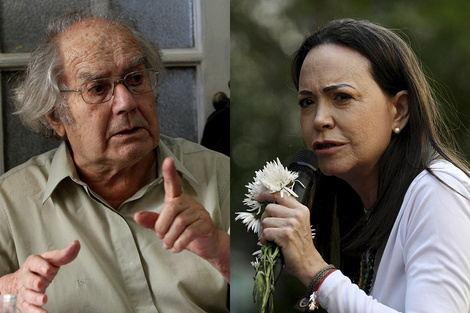
Open Letter from Adolfo Pérez Esquivel to María Corina Machado

Adolfo Pérez Esquivel, Página12, 13/10 /2025
Translated by Tlaxcala


I send you the greeting of Peace and Good, so greatly needed by humanity and by peoples living amid poverty, conflict, war, and hunger.
This open letter is meant to express and share a few reflections.

I was surprised by your designation as Nobel Peace Prize laureate, awarded by the Nobel Committee. It brought back memories of the struggles against dictatorships across our continent and in my own country — the military dictatorships we endured from 1976 to 1983. We resisted prisons, torture, and exile, with thousands of disappeared persons, abducted children, and the death flights, of which I am a survivor.

In 1980, the Nobel Committee awarded me the Nobel Peace Prize. Forty-five years have passed, and we continue working in service of the poorest, alongside the peoples of Latin America. In their name, I accepted that high distinction — not for the prize itself, but for the commitment shared with the peoples who struggle and hope to build a new dawn.
Peace is built day by day, and we must be consistent between what we say and what we do.

At 94, I remain a student of life, and your social and political stances concern me. Therefore, I send you these reflections.

The Venezuelan government is a democracy with its lights and shadows. Hugo Chávez charted the path of freedom and sovereignty for his people and fought for continental unity — a reawakening of the Great Homeland. The United States attacked him constantly: it cannot allow any country in the Americas to escape its orbit and colonial dependence. It still views Latin America as its “backyard.”
The U.S. blockade against Cuba, lasting over 60 years, is an attack on freedom and the rights of peoples. The Cuban people’s resistance stands as a lesson in dignity and strength.

I am astonished by how tightly you cling to the United States: you must know that it has no allies or friends — only interests.
The dictatorships imposed in Latin America were orchestrated to serve its aims of domination, destroying the social, cultural, and political life of peoples striving for freedom and self-determination.
We, the peoples, resist and fight for our right to be free and sovereign, and not colonies of the United States.

The government of Nicolás Maduro lives under the constant threat of the United States and its blockade — one need only recall the U.S. naval forces stationed in the Caribbean and the danger of invasion.
You have not uttered a word, nor condemned this interference by a great power against Venezuela. Yet the Venezuelan people are ready to face the threat.

Corina, I ask you: why did you call on the United States to invade Venezuela?
Upon learning of your Nobel Peace Prize, you dedicated it to Trump — the aggressor of your own country, the man who lies and accuses Venezuela of being a narco-state, a falsehood akin to George Bush’s claim that Saddam Hussein possessed “weapons of mass destruction.”
That was the pretext to invade Iraq, plunder it, and cause thousands of deaths among women and children.
I was in Baghdad at the end of the war, in a children’s hospital, and saw with my own eyes the destruction and death caused by those who proclaim themselves defenders of freedom.
The worst form of violence is the lie.

Do not forget, Corina, that Panama was invaded by the United States, causing death and destruction to capture a former ally, General Noriega.
The invasion left 1,200 dead in Los Chorrillos.
Today, the U.S. once again seeks to reclaim control of the Panama Canal.
It is a long list of U.S. interventions and suffering inflicted upon Latin America and the world.
The veins of Latin America remain open, as Eduardo Galeano once wrote.

I am troubled that you dedicated your Nobel not to your people, but to the aggressor of Venezuela.
I believe, Corina, you must reflect and understand where you stand — whether you are merely another piece in the U.S. colonial system, submissive to its interests of domination, which can never serve the good of your people.
As an opponent of the Maduro government, your stances and choices create much uncertainty, especially when you call for a foreign invasion of your homeland.

Remember that building peace requires great strength and courage for the good of your people — a people I know and deeply love.
Where once there were shantytowns clinging to the hills, surviving in poverty and destitution, there are now decent homes, healthcare, education, and culture.
The dignity of a people cannot be bought or sold.

Corina, as the poet* says:

“Traveler, there is no path; the path is made by walking.”

You now have the chance to work for your people and build peace, not provoke greater violence.
One evil cannot be cured by a greater evil: we would have two evils and never a solution.

Open your mind and your heart to dialogue, to meeting your people.
Empty the jug of violence and build peace and unity among your people, so that the light of freedom and equality may finally enter.

*Another Machado, named Antonio (no relation to Mrs. María Corina) [Transl. n.]