Une parodie dans le style de la presse people, suivie d’une notice biographique factuelle sur celle qui fut « Notre femme à Athènes »

Français
– English
- Español-
Português
- Italiano
– Deutsch


Populist realism, civilizationalism,
and the right
On the intellectual history of contemporary US foreign policy
Realismo populista,
civilizacionismo y derecha
Sobre la historia intelectual de la política exterior usamericana
contemporánea
Réalisme
populiste, civilisationnisme et droite
Sur l’histoire intellectuelle de la
politique étrangère américaine contemporaine
Quatre scénarios possibles d’un clash inéluctable entre le chien et sa queue (les avis divergent sur la question de savoir qui est le chien et qui est la queue)

Mostafa Ahmed, Centre de Recherche Al Habtoor, 18/3/2026
Original : من شركاء حرب إلي خصوم سياسة… هل تشعل إيران الخلاف بين ترامب ونتنياهو؟
English : From Wartime Partners to Political Rivals… Could Iran Ignite a Rift Between Trump and Netanyahu?
Traduit par Tlaxcala
Le partenariat stratégique entre les USA et Israël a longtemps démontré une capacité exceptionnelle à absorber et à gérer les divergences tactiques. Pourtant, les développements accompagnant le lancement de l’opération US « Epic Fury » menée parallèlement à l’opération israélienne « Silent Holy City » fin février 2026, ont soumis cette alliance à un test sans précédent dans le Moyen-Orient moderne. Bien que cette campagne coordonnée ait initialement remporté des succès opérationnels décisifs, notamment l’élimination du guide suprême iranien et le démantèlement de la structure de commandement du Corps des Gardiens de la Révolution islamique (CGRI), l’image d’alignement complet projetée par Trump et Netanyahou dissimule des divergences fondamentales de visions et d’objectifs.
Une lecture attentive de la trajectoire historique de cette relation, parallèlement à ses contraintes politiques actuelles, suggère qu’un conflit prolongé mettra en lumière la vive divergence des intérêts stratégiques des deux capitales. Alors que la confrontation passe de frappes rapides à une guerre d’usure régionale complexe dont les conséquences s’étendent au-delà de Washington et Tel-Aviv, ces différences évolueront probablement vers des fractures structurelles profondes. Cet article propose une analyse stratégique de cette dynamique émergente, soutenant que les différences fondamentales dans la capacité à absorber les répercussions économiques, à gérer les pertes humaines et à naviguer dans des calendriers électoraux rigides transformeront les désaccords tactiques feutrés en une rupture stratégique ouverte qu’il sera de plus en plus difficile de contenir ou de nier.
„Warum gibt Iran nicht auf?“ – Trumps Frage zeigt das Iran-Desaster
Jour 17 de la guerre contre l’Iran. Attendez, laissez-moi le répéter : jour 17.
Et savez-vous ce qui se passe en ce moment dans les couloirs de la Maison-Blanche ? Donald Trump est assis dans son bureau et pose à ses conseillers une question qui change tout : Pourquoi les Perses ne se rendent-ils pas ?
Le Wall Street Journal l’a révélé. L’homme le plus puissant du monde est surpris. Je répète : surpris. L’homme qui affirmait que cette guerre serait terminée très rapidement. Celui qui prétendait que l’Iran n’avait plus de marine, plus d’aviation.
Cet homme ne comprend pas pourquoi Téhéran continue de se battre. Et voici la partie qui m’a tenu éveillé toute la nuit : ses conseillers le poussent, en privé, à chercher une porte de sortie. En privé. Cela signifie qu’en public ils parlent de victoire, mais derrière des portes closes, c’est la panique totale. C’est un aveu de faiblesse.
Trump s’attendait à une victoire rapide. Une répétition de sa guerre de 12 jours en juin dernier. Mais la réalité est complètement différente.
Après 17 jours, l’Iran continue de tirer des missiles, a miné le détroit d’Ormuz et — accrochez-vous — exporte plus de pétrole qu’avant la guerre. Plus 30 %. Laissez ça vous pénétrer.
Les USA bombardent l’Iran depuis plus de deux semaines, auraient frappé 6 000 cibles, détruit la marine iranienne, neutralisé l’aviation. Et pourtant, les exportations de pétrole iraniennes augmentent. Comment est-ce possible ? La Chine.
Les Chinois achètent chaque baril que Téhéran propose. Pas de sanctions, pas de règles, seulement du business. Pendant que Trump pensait mettre l’Iran à genoux, les mollahs ont redirigé leurs navires, activé de nouvelles routes commerciales et gagnent plus d’argent qu’avant.
Le Wall Street Journal rapporte que Trump pose sans cesse la même question en réunion : pourquoi ne capitulent-ils pas ? Ses conseillers n’ont pas de réponse. Ou plutôt, ils en ont une, mais Trump ne veut pas l’entendre.
La réponse est simple : parce que le plan a échoué. Parce que l’armée américaine peut frapper des cibles, mais ne peut pas bombarder des solutions politiques depuis les airs. Parce que l’Iran est un adversaire très différent de l’Afghanistan ou de l’Irak.
Attendez, ça devient encore pire. Les déclarations publiques de Trump changent chaque jour. D’abord : capitulation inconditionnelle. Puis : très bientôt terminé. Puis : pratiquement plus rien à bombarder.
Et maintenant cette question désespérée : pourquoi ne se rendent-ils pas ? Ce n’est pas une stratégie. C’est de l’improvisation. C’est un président qui réalise que son plus grand pari de politique étrangère est en train de déraper.
Les Républicains deviennent nerveux. Les sondages montrent que la majorité des Américains est contre cette guerre. Le prix du pétrole a dépassé les 100 dollars le baril, atteignant brièvement 119 dollars.
Aux stations-service aux USA, les gens paient des prix record. Les élections de mi-mandat approchent, et les conseillers de Trump le savent : si la guerre continue encore quelques semaines, nous perdrons le Congrès.
D’où la fuite vers le Wall Street Journal. D’où la pression privée pour que Trump trouve un plan de sortie. Ils essaient de pousser doucement le président vers la sortie sans qu’il perde la face.
Mais Trump reste Trump. Il ne peut pas simplement arrêter. Il doit annoncer une victoire, même s’il n’y en a pas.
Alors il dit à la presse : « Nous sommes très en avance sur le calendrier. » C’est un langage orwellien. « En avance sur le calendrier » signifie, dans le monde de Trump : nous n’avons plus de calendrier, parce que le plan initial s’est effondré.
Et voilà le point essentiel : l’Iran le sait. Les Gardiens de la Révolution ont publié une déclaration.
C’est l’Iran qui décidera quand la guerre prendra fin.
C’est une réponse directe aux affirmations de Trump. Téhéran dit à l’homme le plus puissant du monde en face : tu ne contrôles pas cette guerre. Nous la contrôlons.
Et les faits leur donnent raison.
„Warum gibt Iran nicht auf?“ – Trumps Frage zeigt das Iran-Desaster
Day 17 of the war with Iran. Wait, let me say that again: day 17.
And do you know what is happening right now in the corridors of the White House? Donald Trump is sitting in his office asking his advisors a question that changes everything: Why aren’t the Persians giving up?
The Wall Street Journal leaked it. The most powerful man in the world is surprised. I repeat: surprised. The man who said this war would end very soon. The man who claimed Iran no longer had a navy or an air force.
This man does not understand why Tehran keeps fighting. And here comes the part that kept me awake all night: his advisors are privately urging him to find an exit. Privately. That means publicly they talk about victory, but behind closed doors there is total panic. That is an admission of weakness.
Trump expected a quick victory. A repeat of his 12-day war last June. But reality looks completely different.
After 17 days, Iran is still firing missiles, has mined the Strait of Hormuz and — here’s the kicker — is exporting more oil than before the war. Plus 30%. Let that sink in.
The United States has been bombing Iran for over two weeks, allegedly hitting 6,000 targets, destroying the Iranian navy and disabling the air force. And yet Iranian oil exports are rising. How is that possible? China.
The Chinese take every barrel Tehran offers. No sanctions, no rules, just business. While Trump thought he would bring Iran to its knees, the mullahs rerouted their ships, activated new trade routes, and are making more money than before.
The Wall Street Journal reports that Trump keeps asking the same question in meetings: why aren’t they capitulating? His advisors have no answer. Or rather, they do have an answer, but Trump does not want to hear it.
The answer is: because the plan has failed. Because the American military can hit targets, but cannot bomb political solutions out of the sky. Because Iran is a very different opponent from Afghanistan or Iraq.
Wait, it gets worse. Trump’s public statements change daily. First unconditional surrender, then “very soon over,” then “almost nothing left to bomb.”
And now this desperate question: why aren’t they giving up? This is not strategy. This is improvisation. This is a president realizing that his biggest foreign policy gamble is spiraling out of control.
Republicans are getting nervous. Polls show that the majority of Americans oppose this war. Oil prices have surged above $100 per barrel, briefly reaching $119.
At gas stations across the United States, people are paying record prices. The midterm elections are coming, and Trump’s advisors know: if the war continues for weeks, we lose Congress.
That’s why the leak to the Wall Street Journal. That’s why the private push for an exit plan. They are trying to gently steer the president toward the exit without him losing face.
But Trump is Trump. He cannot just stop. He has to declare victory, even if there isn’t one.
So he tells the press: “We are far ahead of schedule.” That is Orwellian language. “Ahead of schedule” means, in Trump’s world: we no longer have a schedule because the original plan has collapsed.
And here is the thing: Iran knows it. The Revolutionary Guards issued a statement.
Iran will decide when the war ends.
That is a direct response to Trump’s claims. Tehran is telling the most powerful man in the world to his face: you do not control this war. We do.
And the facts prove them right.
Malek Dudakov, Команда Трампа разбегается, 17 mars 2026
Traduit par Tlaxcala
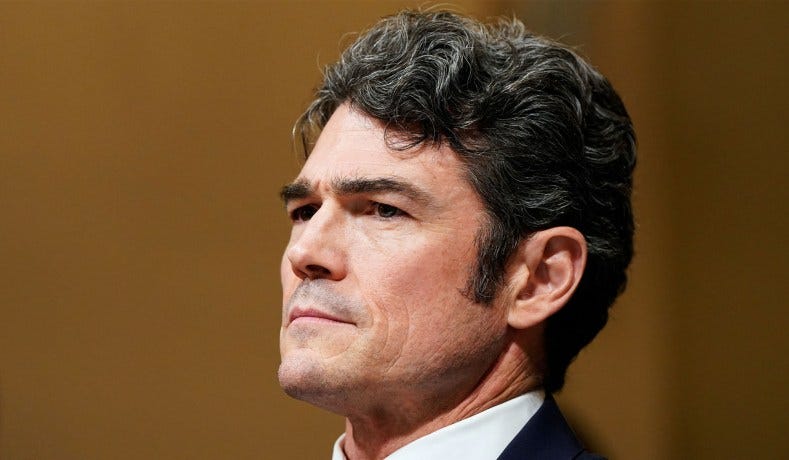
Le directeur du Centre national antiterroriste usaméricain, Joe Kent - un protégé de la cheffe du bureau du renseignement national, Tulsi Gabbard - démissionne, accusant le lobby israélien de provoquer une guerre avec l’Iran. Joe Kent est un ancien Béret vert, ayant servi 20 ans dans l’armée US.
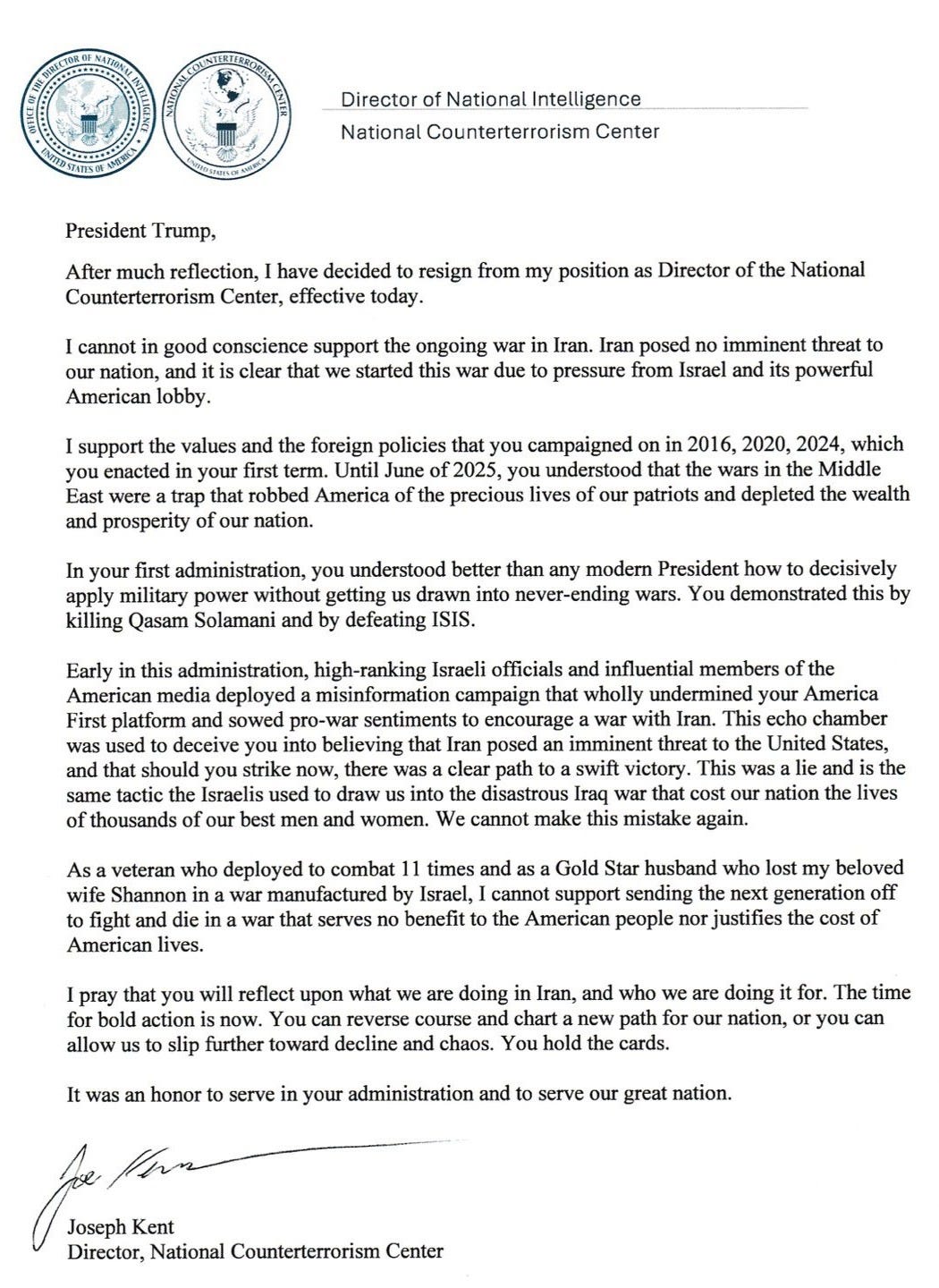
[…] “Je ne peux pas, en conscience, soutenir la guerre en cours contre l’Iran. L’Iran ne représentait aucune menace imminente pour notre nation, et il est clair que nous avons déclenché cette guerre sous la pression d’Israël et de son puissant lobby américain.” […]
Il connaît bien la guerre, contrairement à de nombreux faucons de salon comme Ben Shapiro ou Mark Levin, qui prônent activement la poursuite de l’escalade. Kent a également servi en tant qu’officier militaire détaché auprès de la CIA. D’ailleurs, Langley s’efforce également de ne pas s’impliquer directement dans l’aventure iranienne. Ils ont tout laissé à Pete Hegseth.
Tulsi Gabbard sabote également la guerre avec l’Iran. Elle a récemment publié, avec la CIA, un rapport conjoint affirmant qu’il ne faut pas s’attendre à un changement de régime à Téhéran. Les services de renseignement usaméricains affirment avoir prévenu Trump à l’avance des risques d’escalade. Mais il n’a voulu écouter personne.
En attendant, autour de Gabbard, commencent à se rassembler des apparatchiks du Pentagone qui sont mécontents de l’attitude militariste de Hegseth.
En fait, nous assistons actuellement à une véritable guerre entre les faucons et les isolationnistes dans l’équipe de Trump, au milieu du chaos dans lequel ils se sont embourbés.
Les prix du diesel aux USA ont bondi de 40% et ont dépassé pour la première fois depuis 2022 les cinq dollars le gallon. Les porte-avions usaméricains rencontrent des difficultés, et il est peu probable qu’ils puissent mener une campagne pendant longtemps. Il n’a pas été possible de débloquer le détroit d’Ormuz, et l’Europe et la Chine ont refusé d’aider Trump. Les premiers licenciements et démissions ont commencé. Ce ne sera pas facile si la guerre avec l’Iran dure jusqu’en avril. Beaucoup de gens vont alors fuir un navire qui coule.
President Trump,
Après mûre réflexion, j’ai décidé de démissionner de mon poste de directeur du Centre national de contre-terrorisme, avec effet immédiat.
Je ne peux pas en mon âme et conscience soutenir la guerre en cours en Iran. L’Iran ne représentait aucune menace imminente pour notre nation, et il est clair que nous avons commencé cette guerre sous la pression d’Israël et de son puissant lobby américain.
Je soutiens les valeurs et les politiques étrangères sur lesquelles vous avez fait campagne en 2016, 2020, 2024, et que vous avez mises en œuvre durant votre premier mandat. Jusqu’en juin 2025, vous compreniez que les guerres au Moyen-Orient étaient un piège qui privait l’Amérique des vies précieuses de nos patriotes et épuisait la richesse et la prospérité de notre nation.
Durant votre première administration, vous avez mieux que tout président moderne compris comment appliquer la puissance militaire de manière décisive sans nous entraîner dans des guerres sans fin. Vous l’avez démontré en tuant Qassem Soleimani et en vainquant Daesh.
Au début de cette administration, des responsables israéliens de haut rang et des membres influents des médias américains ont déployé une campagne de désinformation qui a totalement miné votre plateforme “America First” et semé des sentiments pro-guerre pour encourager un conflit avec l’Iran. Cette chambre d’écho a été utilisée pour vous tromper en vous faisant croire que l’Iran représentait une menace imminente pour les États-Unis, et qu’en frappant maintenant, il y avait une voie claire vers une victoire rapide. C’était un mensonge et c’est la même tactique que les Israéliens ont utilisée pour nous entraîner dans la désastreuse guerre d’Irak qui a coûté à notre nation la vie de milliers de nos meilleurs hommes et femmes. Nous ne pouvons pas refaire cette erreur.
En tant que vétéran ayant été déployé au combat 11 fois et en tant qu’époux de Gold Star [parent/conjoint endeuillé par la guerre] ayant perdu mon épouse bien-aimée Shannon dans une guerre fabriquée par Israël, je ne peux pas soutenir l’envoi de la prochaine génération se battre et mourir dans une guerre qui n’apporte aucun bénéfice au peuple américain et ne justifie pas le coût en vies américaines.
Je prie pour que vous réfléchissiez à ce que nous faisons en Iran, et pour qui nous le faisons. Le moment est venu d’agir avec audace. Vous pouvez inverser la tendance et tracer une nouvelle voie pour notre nation, ou vous pouvez nous laisser glisser davantage vers le déclin et le chaos. Vous avez les cartes en main.
Ce fut un honneur de servir dans votre administration et de servir notre grande nation.
Après “La victoire [usaméricaine] qui terrifie l’Arabie saoudite”, nous proposons ici la traduction en français de deux articles publiés à une semaine d’intervalle par Policy Tensor, en commençant par le plus récent, daté du 16 mars 2026.

Les conséquences géopolitiques de la défaite, par Policy Tensor
Substack, Policy Tensor, The Geopolitical Consequences of Defeat, 16 mars 2026.
Quand un étudiant en relations internationales dit que le monde est unipolaire ou bipolaire, il émet en fait une hypothèse sur la répartition de la puissance. Dans un monde unipolaire, l’idée sous-jacente est qu’aucun autre État n’est capable de véritablement rivaliser avec le plus puissant. Si un État se révèle capable de le faire, alors cette hypothèse tombe à l’eau.
Comme je l’expliquais dans mon précédent article [Cf. plus bas pour la version française, après le présent article], les USA sont aujourd’hui au bord d’une défaite stratégique. Je ne dis pas que c’est joué d’avance, mais que ce scénario est devenu bien plus qu’une simple possibilité : c’est l’hypothèse centrale à envisager.
Pour être concret : si les USA échouent à neutraliser les attaques iraniennes dans le Golfe, s’ils sont incapables de rouvrir par la force le détroit d’Ormuz, ce sera une défaite stratégique. Une défaite qui prouverait que le monde n’est ni unipolaire, ni bipolaire, ni même tripolaire, mais bien multipolaire – avec l’Iran comme l’un de ses pôles. Alors, quelles seraient les conséquences géopolitiques d’un tel retournement ?
Mais avant d’en arriver là, reprenons les éléments clés du raisonnement.
Pour éviter la défaite, les USA n’ont qu’une seule option : détruire ou neutraliser les capacités iraniennes qui menacent les installations du Golfe et maintiennent Ormuz fermé. Si l’armée usaméricaine n’y parvient pas, par la force directe ou par la coercition, le résultat sera vécu comme une défaite stratégique – même si la guerre s’arrête sur un cessez-le-feu. Car alors, le monde entier aura vu que les USA ne peuvent plus imposer leur volonté dans cette région.
Tout repose donc sur la campagne d’interdiction, cette opération visant à détruire les moyens de frappe iraniens (drones, missiles, lanceurs, etc.).
Même si cette campagne réussit à dégrader rapidement ces capacités, la victoire ne sera pas pour autant acquise. Il faudra encore, si les Iraniens minent le détroit – ce qu’ils auraient déjà commencé à faire – mener des opérations de déminage. Or, le déminage en contexte hostile est un problème militaire loin d’être résolu, et qui prendrait lui aussi des mois.
Ce que j’ai montré dans mon précédent article, c’est que même avec des hypothèses optimistes, la campagne d’interdiction prendra de très longs mois – assez pour infliger des dégâts considérables à l’économie mondiale et à la présidence Trump.
Car dans cette guerre, le temps joue pour l’Iran.
Plus le conflit dure, plus l’Iran peut imposer des coûts élevés aux USAméricains et à l’économie globale. Si, à l’avenir, les présidents usaméricains hésitent à attaquer l’Iran de peur d’en payer le prix, alors Téhéran aura gagné son objectif principal : rétablir une dissuasion crédible.
Mohammed Omar, houseofsaud.com, 16/3/2026
Traduit par Tlaxcala
Trump a demandé à 6 pays d’envoyer des navires de guerre à Ormuz. Aucun ne s’y est engagé. L’Inde et la Chine ont plutôt conclu des accords avec l’Iran. Ce que l’échec de la coalition signifie pour la sécurité saoudienne.
RIYAD — Le 14 mars, le
président Donald Trump a appelé six pays à envoyer des navires de guerre dans
le détroit d’Ormuz, promettant une flotte multinationale qui briserait le
blocus iranien et rétablirait le flux de vingt pour cent du pétrole mondial.
Deux jours plus tard, pas un seul pays n’a publiquement engagé de navire. La
France a mis des conditions. L’Allemagne a jugé le plan irréaliste. Le Japon a
invoqué des barrières constitutionnelles. La Corée du Sud est restée
silencieuse. L’Inde et la Chine ont contourné entièrement la coalition,
négociant leur propre passage avec Téhéran. La flotte qui était censée sauver
les marchés mondiaux de l’énergie n’existe que dans un message présidentiel sur
les réseaux sociaux — et pour l’Arabie saoudite, qui observe derrière son
bouclier antimissile fourni par les USA, ce silence porte un message bien plus
conséquent que n’importe quel déploiement de navire de guerre : l’architecture
de sécurité qui a protégé le Royaume pendant un demi-siècle pourrait ne plus
fonctionner quand elle compte le plus.

SOMMAIRE
·
Qu’a demandé Trump exactement dans le détroit d’Ormuz ?
·
Pourquoi aucun pays n’a-t-il publiquement engagé de
navires de guerre dans le détroit ?
·
L’offre conditionnelle de la France et les limites de
la puissance européenne
·
Pourquoi l’Allemagne et le Japon ne peuvent ou ne
veulent pas envoyer de navires
·
Comment l’Inde, la Chine et la Turquie négocient leurs
propres accords avec Téhéran
·
Qu’est-ce que le Pentagone a mal évalué concernant
Ormuz ?
·
La matrice de préparation de la coalition
·
La Grande-Bretagne a envoyé des avions mais la Royal
Navy est restée à quai
·
Que signifie l’échec de la coalition pour l’Arabie
saoudite ?
·
L’Arabie saoudite a-t-elle déjà commencé à construire
une architecture de sécurité post-américaine ?
·
Pourquoi la coalition de la guerre des pétroliers de
1987 a fonctionné et celle-ci ne le peut pas
·
Le détroit d’Ormuz rouvrira-t-il sans une flotte
multinationale ?
·
Foire aux questions
Qu’a demandé Trump
exactement dans le détroit d’Ormuz ?
Le 14 mars 2026, le
président Trump a publié sur Truth Social que « de nombreux pays »
enverraient des navires de guerre aux côtés des forces navales usaméricaines
pour maintenir le détroit d’Ormuz « ouvert et sûr ». Il a
spécifiquement nommé la Chine, la France, le Japon, la Corée du Sud et le
Royaume-Uni — des pays dont les économies dépendent du flux ininterrompu d’énergie
du Golfe — et les a exhortés à déployer immédiatement des forces navales dans
la région. Le message marquait la première reconnaissance publique par l’administration
que les USA ne disposent pas des ressources nécessaires pour rouvrir le détroit
seuls.
L’appel est intervenu au
15e jour de la guerre qui a commencé lorsque les USA et Israël ont
lancé l’opération Epic Fury le 28 février, tuant le guide suprême iranien Ali
Khamenei et frappant le programme de missiles du pays, ses installations
nucléaires et les infrastructures du Corps des Gardiens de la révolution
islamique. La réponse de l’Iran a inclus des attaques soutenues de missiles et
de drones contre des bases militaires usaméricaines dans tout le Golfe, des
frappes sur l’Arabie saoudite, les Émirats arabes unis, Bahreïn, le Koweït, le
Qatar et Oman, et la fermeture effective du détroit d’Ormuz par une combinaison
de menaces de missiles antinavires, d’opérations de pose de mines et de
patrouilles de la marine du CGRI exigeant une autorisation de passage.
Le secrétaire à la Guerre, Pete Hegseth, a simultanément annoncé le déploiement du navire d’assaut amphibie USS Tripoli et de son unité expéditionnaire de marines au Moyen-Orient. Les marines seraient capables de mener des opérations au sol si l’ordre en était donné — une escalade significative par rapport à la campagne purement navale et aérienne que le Pentagone avait initialement envisagée. Hegseth a déclaré à des journalistes lors d’un briefing au Pentagone que l’Iran « faisait preuve de pur désespoir dans le détroit d’Ormuz » et a insisté sur le fait que la situation était sous contrôle : « Nous y faisons face, et il n’y a pas lieu de s’inquiéter ».
Le décalage entre les
dénis de Hegseth et l’appel de Trump à des navires étrangers racontait deux
histoires contradictoires. Si la situation était sous contrôle, pourquoi
demander de l’aide à six pays ? Si les USA avaient besoin d’une coalition,
pourquoi le Pentagone n’en avait-il pas préparé une avant de déclencher une
guerre dont les experts avertissaient depuis des décennies qu’elle
déclencherait exactement ce scénario ?
Pourquoi aucun pays n’a-t-il
publiquement engagé de navires de guerre dans le détroit ?
Milena Rampoldi, 15/3/2026
Depuis le déclenchement de l’agression d’Usraël contre la République
islamique d’Iran, je me sens comme le théologien allemand Dietrich Bonhoeffer
quand il était dans la prison nazie, même si mon bureau à Istanbul est beaucoup
plus confortable. Dans sa cellule, Bonhoeffer a commencé à réfléchir sur les
raisons et les racines du régime hitlérien brutal en comprenant que la cause n’était
pas la malveillance/le mal mais simplement la stupidité pure et simple.

Le même paradigme peut être appliqué à la présidence de Donald Trump et à
sa guerre épiquement furieuse contre le régime satanique de l’Iran alors qu’en
réalité ce n’est rien d’autre que l’agression brutale et échevelée contre un
État souverain du Machrek.
|
« Nous
avons cherché à plusieurs reprises à conclure un accord. Nous avons essayé.
Ils voulaient le faire. Ils ne voulaient pas le faire. Ils voulaient le
faire. Ils ne voulaient pas le faire. |
Dans ses lettres écrites de prison, le théologien Bonhoeffer affirmait que
la stupidité était un ennemi plus dangereux pour le bien que la malveillance
et/ou le mal lui-même. Pour moi personnellement, sa conclusion a un fort impact
sur la façon de lutter contre les violations des droits humains comme les
guerres usaméricaines contre les États musulmans souverains. Nous vivons un
changement de paradigme important si nous abandonnons le point de vue selon
lequel nous devrions lutter contre le mal usaméricain et si nous disons plutôt
que la stupidité usaméricaine est l’ennemie des pays musulmans souverains du
Machrek comme la stupidité est l’ennemie de l’autodétermination politique et de
l’anticolonialisme/anti-impérialisme.
|
« La vie
de courageux héros américains peut être perdue et nous pouvons avoir des
victimes, ce qui arrive souvent en temps de guerre. Nous le faisons, pas pour
maintenant, nous le faisons pour l’avenir, et c’est une noble mission. » |
Cependant, Bonhoeffer va même plus loin dans ses réflexions en montrant que la violence n’est même pas capable de s’opposer à la stupidité alors qu’elle est un moyen efficace lorsqu’il faut s’opposer au mal. Si nous partons de l’hypothèse que Trump représente la stupidité et non le mal, nous comprendrons que nous devons changer notre stratégie pour nous opposer à ses fantasmes néo-impérialistes tueurs d’enfants dans les pays musulmans et autres (Venezuela, Cuba et plus).
Pourquoi la stupidité est-elle si dangereuse en politique ? Bonhoeffer
a la réponse : La stupidité est mise entre parenthèses par la majorité des
gens parce que beaucoup pensent qu’elle ne vaut pas la peine d’être prise en
compte. Et c’est une erreur parce que nous ne comprenons alors pas l’essence de
la stupidité qui – selon les mots de Bonhoeffer lui-même – n’est pas un défaut
intellectuel mais un défaut « humain ».
Si nous analysons le phénomène de la stupidité d’un point de vue
psychologique puis sociologique, nous en comprenons une caractéristique
fondamentale : la stupidité apparaît dans les groupes plus que dans les
personnes isolées. Trump et sa stupidité font partie d’un système, d’un mode de
vie usaméricain où les contribuables financent des attaques stupides contre des
écoles de filles, des musées et des hôpitaux en Iran.
|
« Mais
oui, vous savez, nous nous attendons à certaines choses. Comme je l’ai dit,
certaines personnes vont mourir. Quand vous allez à la guerre, certaines
personnes mourront. » |
Si nous écoutons ce que Bonhoeffer suggère, nous devons passer de la marionnette isolée Donald au système « Epstein » dont il fait partie. Cela signifie que la stupidité n’est pas un problème psychologique mais devient un problème sociologique. C’est pourquoi nous devrions établir la « sociologie de la stupidité » pour analyser le néo-impérialisme de Trump afin de surmonter l’occupation usaméricaine des pays musulmans et autres.
Dans un régime néocolonialiste comme les USA, le pouvoir
de la classe dirigeante des néo-sionistes assoiffés de pouvoir de l’AIPAC a
besoin de la stupidité des contribuables aveugles pour survivre car la
stupidité et la mégalomanie néo-impérialiste sont l’exact opposé du courage
moral et de la lutte contre l’injustice. Les gens stupides croient au récit de
la classe dirigeante. Et cela se traduit par la persistance d’un
néo-colonialisme USaméricain façonné par le régime sioniste 2.0 régi par les
fantasmes d’Eretz Israël. Ici, dans ce qui suit, je voudrais traduire la
section tirée des lettres de Bonhoeffer écrites de prison intitulée
« Stupidité »[1] pour
permettre aux lecteurs d’y réfléchir, de remodeler leur propre courage moral
car nous avons besoin d’une guerre contre la stupidité et non contre le
mal :
« La stupidité est un ennemi du bien plus dangereux que la méchanceté.
Contre le mal, on peut protester ; on peut le dénoncer ; on peut, au besoin, l’empêcher par la force. Le mal porte toujours en lui le germe de sa propre dissolution, puisqu’il laisse au moins un malaise dans l’être humain. Face à la stupidité, en revanche, nous sommes sans défense.
Ni les protestations ni la force n’y peuvent rien ; les raisons n’y ont aucune prise. Les faits qui contredisent les préjugés n’ont tout simplement pas besoin d’être crus – dans ces cas-là, le stupide devient même critique – et, s’ils sont inévitables, ils sont écartés comme de simples exceptions sans importance.
Contrairement au méchant, le stupide est entièrement satisfait de lui-même ; il devient même dangereux, car il passe facilement à l’attaque dès qu’il est irrité.
C’est pourquoi il faut se montrer plus prudent envers le stupide qu’envers le méchant. Nous ne tenterons jamais de convaincre le stupide par des arguments : c’est inutile et dangereux.
Pour savoir comment lutter contre la stupidité, nous devons d’abord essayer d’en comprendre la nature. Une chose est certaine : elle n’est pas essentiellement un défaut intellectuel, mais un défaut humain. Il existe des personnes intellectuellement très vives qui sont stupides, et d’autres intellectuellement lourdes qui ne le sont pas du tout.
On découvre cela, souvent avec surprise, dans certaines situations. On a moins l’impression que la stupidité soit un défaut inné que le sentiment que, dans certaines circonstances, les gens sont rendus stupides – ou se laissent rendre stupides.
On observe également que les personnes vivant isolées et retirées manifestent ce défaut plus rarement que les individus ou les groupes enclins à la sociabilité. La stupidité semble donc être moins un problème psychologique qu’un problème sociologique. Elle est une forme particulière de l’influence des circonstances historiques sur l’être humain, une manifestation psychologique de certaines conditions extérieures.
En y regardant de plus près, on constate que toute forte expansion du pouvoir – qu’elle soit politique ou religieuse – frappe une grande partie des êtres humains de stupidité. Il semble même que ce soit une sorte de loi socio-psychologique : le pouvoir des uns a besoin de la stupidité des autres.
Le processus n’est pas que certaines capacités – intellectuelles par exemple – se détériorent soudainement. C’est plutôt que, sous l’impression écrasante du déploiement du pouvoir, l’être humain est privé de son indépendance intérieure et renonce alors, plus ou moins consciemment, à trouver par lui-même une attitude face aux situations de la vie.
Le fait que le stupide soit souvent obstiné ne doit pas masquer qu’il n’est pas autonome. Dans la conversation avec lui, on a l’impression de ne pas parler avec une personne, mais avec des slogans, des mots d’ordre et des formules qui se sont emparés de lui.
Il est sous un charme, aveuglé, abusé et maltraité dans son être même. Devenu un instrument sans volonté, le stupide sera capable de tout mal, tout en étant incapable de reconnaître ce mal comme tel. C’est là que réside le danger d’un abus diabolique.
Cependant, il apparaît aussi clairement ici que ce n’est pas un acte d’instruction, mais seulement un acte de libération qui peut vaincre la stupidité. Il faudra accepter que, dans la plupart des cas, la libération intérieure ne devienne possible qu’après une libération extérieure.
Jusqu’à ce moment, nous devrons renoncer à toute tentative de convaincre le stupide.
Dans ces conditions, il est également compréhensible que nous nous efforcions en vain de savoir ce que « le peuple » pense réellement – et pourquoi cette question est en réalité superflue pour celui qui pense et agit de manière responsable.
La Bible dit que la crainte de Dieu est le commencement de la sagesse (Psaume 111,10) : cela signifie que la libération intérieure de l’être humain pour une vie responsable devant Dieu est la seule véritable victoire sur la stupidité.
Ces réflexions ont néanmoins quelque chose de consolant : elles n’autorisent absolument pas à considérer la majorité des êtres humains comme stupides en toutes circonstances. Tout dépendra de savoir si les détenteurs du pouvoir comptent davantage sur la stupidité des hommes ou sur leur indépendance intérieure et leur intelligence. »
La conclusion simple est que le trumpisme néo-colonialiste et le donaldisme néo-impérialiste sont un grave problème sociologique entrelacé avec la stupidité apparaissant comme le mal. Et de la stupidité, vous pouvez simplement être libéré, la stupidité ne peut pas être combattue par la violence, et c’est exactement le cas lorsque nous regardons l’occupation du Moyen-Orient par l’armée d’Usraël. Alors que l’Israël sioniste 2.0 a besoin d’implosion, d’autodestruction et de déconstruction, le trumpisme et le donaldisme nécessitent une guerre internationale contre la stupidité.
[1] Le passage est tiré
de Bonhoeffer D., Widerstand und Ergebung:
Briefe und Aufzeichnungen aus der Haft, Gütersloher Verlagshaus, Munich
2005, pp. 14-16.


