
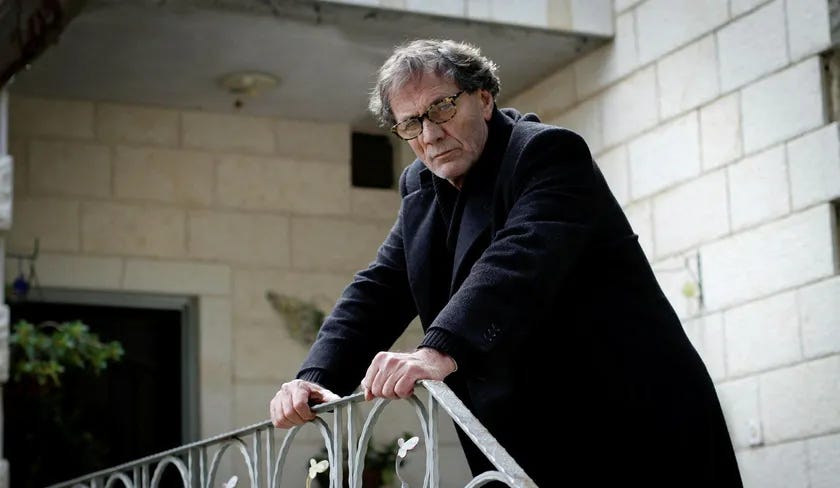
Israel turned its back as Palestinian Israeli society mourned the death of Mohammad Bakri, one of its most celebrated figures: an actor, director, and cultural icon, a Palestinian patriot and a man of noble soul
Gideon Levy, Haaretz, 28/12/2025
The hall adjacent to the mosque in the Galilee village of Bi’ina was crowded on Friday. Thousands of somber-faced people came to pay their respects and left; I was the only Jew among them.
Palestinian Israeli society mourns the death of one of its greatest members, an actor, director and cultural hero, a Palestinian patriot and a man of noble soul – Mohammad Bakri – and Israel, in death as in life, turned its back on him. Only one television station devoted a news item to his passing. A handful of Jews surely came to console his family, but on Friday afternoon, there were none to be seen.
Bakri was laid to rest Wednesday – late at night, at the request of the family – leaving no place in Israel in which to eulogize him, to thank him for his work, to bow our heads before him in appreciation and to ask for his forgiveness.
He deserved all of it. Bakri was an artist and a freedom fighter, the kind written about in history books and for whom streets are named. There was no place for him in ultranationalist Israel, not even after his death.
Israel crushed him, only because he dared to express the Palestinian pain as it is. Long before the dark days of Benjamin Netanyahu and Itamar Ben-Gvir, 20 years before October 7 and the war in Gaza, Israel treated him with a fascism that would not have shamed Likud ministers Yoav Kisch and Shlomo Karhi.
Its celebrated legal establishment rallied as one to condemn his work. A Lod District Court judge banned the screening of his film “Jenin, Jenin,” the attorney general at the time joined the war and the enlightened Supreme Court ruled that the movie was made with “improper motives” – this was the level of the arguments put forth by the beacon of justice.
And all because of a handful of reservists who were “hurt” by his film and sought to settle the score. It was not the residents of the Jenin refugee camp who were hurt, but the soldier Nissim Magnaji. His request was granted and Bakri was destroyed. All this was long before the Dark Ages.
Few came to his aid. The artists fell silent and the handsome star of “Beyond the Walls” was thrown to the dogs. He never recovered.
I once thought that “Jenin, Jenin” would one day be shown in every school in the country, but today it is clear that this won’t happen, not in today’s Israel and presumably not in the future either.
But the Bakri I knew did not anger or hate. I never heard him express a single word of hatred toward those who ostracized him, to those who hurt him and his people. His son Saleh once said: “[Israel] destroyed my life, my father’s life, my family, my nation’s life.” It’s doubtful his father would have expressed himself that way.
On Friday this impressive son stood tall, a kaffiyeh draped over his shoulders, and he and his siblings, of whom their father was so proud, greeted those who came to condole them for their father’s death.
I loved him so much. On a rainy winter night at the Hebrew University of Jerusalem’s Mount Scopus campus, when people shouted “traitors” at us after the screening of “Jenin, Jenin,” and at the Israel Film Center Festival at New York City’s Marlene Meyerson JCC Manhattan, to which he was invited every year, and where protesters also shouted. At Tel Aviv’s erstwhile Cafe Tamar, which he used to visit occasionally on Fridays, and in the painful essays he published in Haaretz. Free of cynicism, innocent as a child and filled with hope just as he was.
His last, and very short, film, “Le Monde,” written by his daughter Yafa, takes place at a birthday party in a luxurious hotel. A girl handed out roses to guests, a violinist played “Happy Birthday,” bombed-out Gaza is on TV and Bakri stood up with the help of a young woman who sat with him and left. He was blind.
Three weeks ago, he wrote to me to tell me he planned to come to the Tel Aviv area for the funeral of a dear man, as he put it, the director Ram Loevy, and I replied that I was ill and we wouldn’t be able to meet. To the best of my knowledge, he also did not go to the funeral in the end.
“Be well and take care of yourself,” the man who never took care of himself wrote me.
Bakri is dead, the Jenin camp is destroyed and all its residents have been expelled, homeless once more in another war crime. And hope still beat in Bakri’s heart, until his death; we did not agree about it.

Aucun commentaire:
Enregistrer un commentaire